

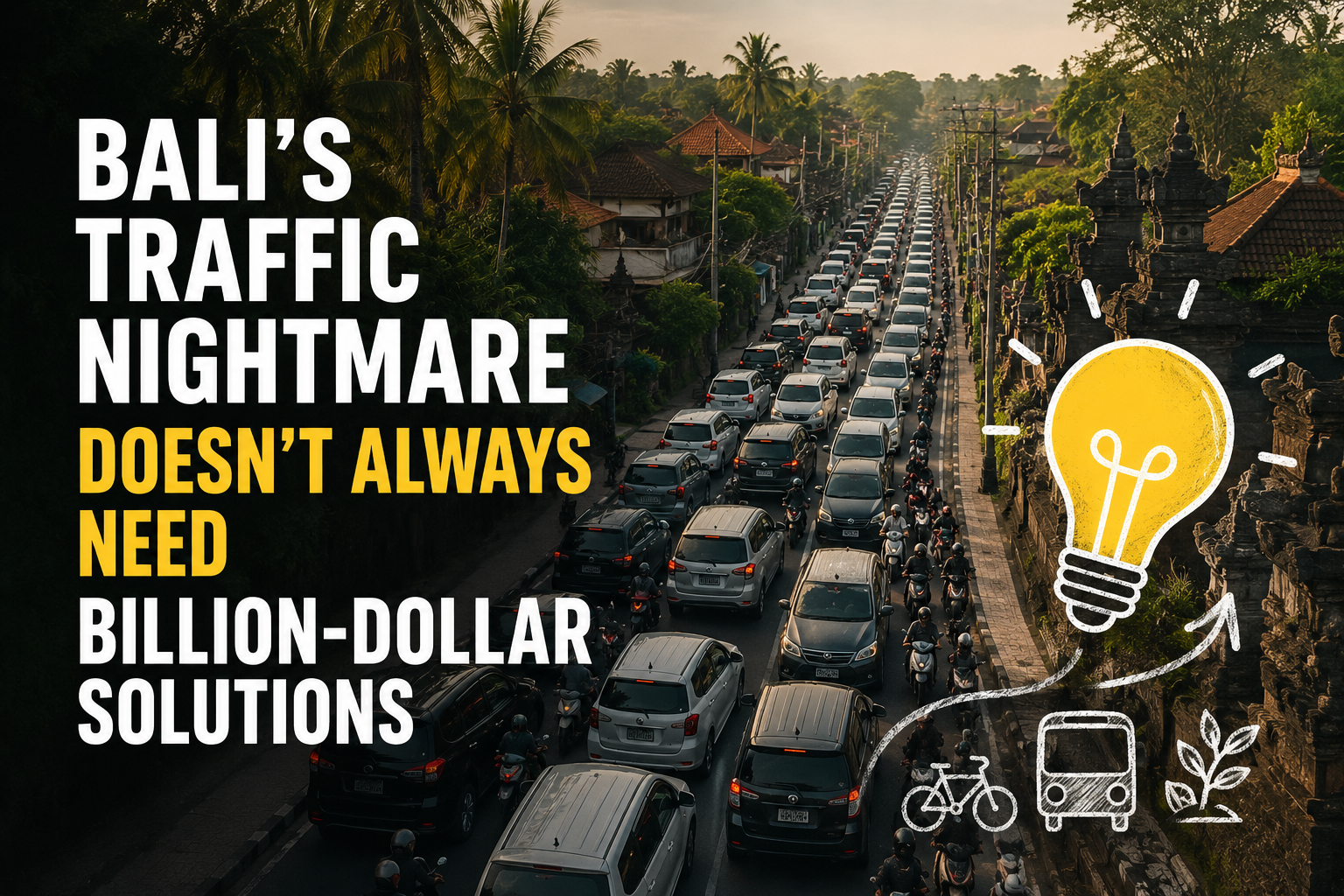
Bali’s Traffic Nightmare Doesn’t Always Need Billion-Dollar Solutions
By Jamie McIntyre
Jamie McIntyre, the Chief Editor of Australian National Review who resides in Bali, Indonesia, says he is constantly looking at practical and affordable solutions to the island’s growing traffic and infrastructure problems caused by rapid development. 🌴🚐
According to McIntyre, many solutions do not need to involve multi-billion-dollar infrastructure projects or decades of construction delays. Often the best ideas are the simplest and most cost-effective.
One concept he suggested for Bali was the idea of a beachfront boardwalk transport corridor running alongside the coastline from the airport through Kuta, Seminyak, Canggu, and Pererenan, helping remove significant pressure from heavily congested roads.
However, McIntyre believes even that may not be necessary.
He argues Bali already has a natural transport corridor available: its beaches.
Instead of waiting years or decades for expensive rail systems and underground MRT developments, Bali could introduce resort-style shuttle buses fitted with oversized beach tyres capable of travelling directly along the sand.
“These vehicles wouldn’t even require roads or a boardwalk,” McIntyre said. “They could move tourists and locals efficiently along the coastline itself, connecting major tourism areas while taking large volumes of traffic off existing roads.”
The concept could allow passengers to travel from near the airport through Bali’s busiest tourism districts without sitting for hours in traffic congestion.
McIntyre says the idea could be introduced relatively inexpensively compared to large-scale rail projects and may largely pay for itself through fares, tourism partnerships, sponsorships, and advertising revenue.
He also raised concerns about Bali’s much-publicised MRT project, which despite major launch announcements and ceremonies over a year ago, many residents believe has seen little visible progress since.
“Mega-projects sound impressive politically, but whether they truly solve Bali’s traffic problems is another question entirely,” McIntyre said.
He noted that train stations themselves often create new congestion points due to the need for parking facilities, taxi pickup areas, feeder transport systems, and road access.
“Without massive supporting infrastructure around every station, congestion simply shifts from one location to another,” he said. “In Bali’s already crowded tourism zones, that may create additional bottlenecks rather than reduce them.”
McIntyre believes Bali’s unique layout, village structure, and tourism-driven economy may be better suited to flexible and creative transport systems rather than attempting to replicate the infrastructure models of densely planned mega-cities.
“Bali doesn’t necessarily need to become Singapore,” he said. “It simply needs smarter, faster, and more affordable solutions that work specifically for Bali.”
He added that while infrastructure investment remains important, innovation should focus not only on expensive engineering projects but also on practical ideas that can be implemented quickly and efficiently.
“Sometimes the smartest solutions are sitting right in front of us,” McIntyre said. “In Bali’s case, that may literally be the beach.” 🌊


