


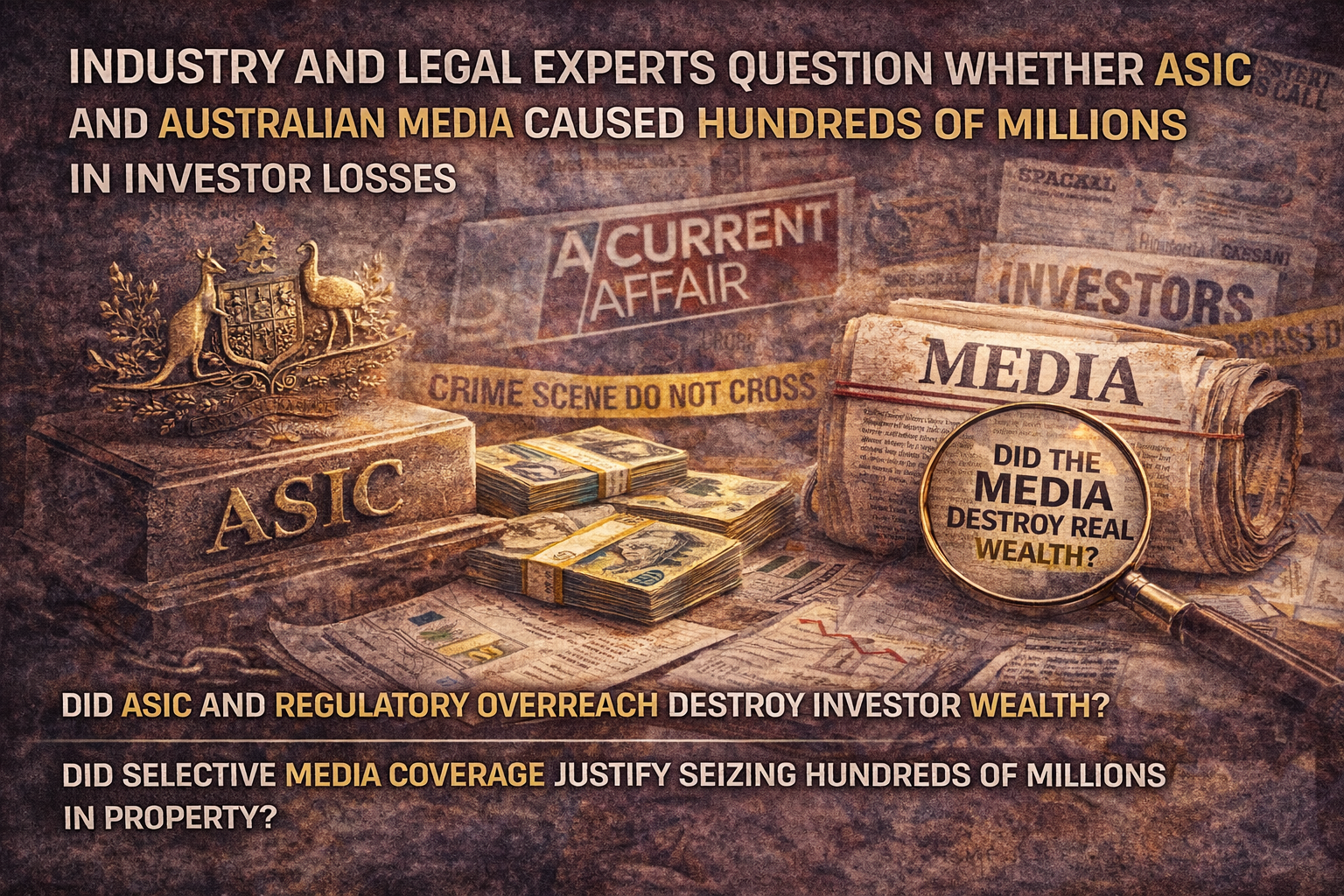
📰 Industry and Legal Experts Question Whether ASIC and Australian Media Caused Hundreds of Millions in Investor Losses
Industry and legal experts are now raising serious questions following Channel Nine’s A Current Affair segment attacking Lux founder Jamie McIntyre and his multi-billion-dollar Marina Bay City project in Lombok, Indonesia.
The broadcast attempted to discredit McIntyre by:
1️⃣ Falsely implying construction had stopped — a claim later contradicted within the broadcast itself
2️⃣ Reviving ASIC action from over a decade ago, including McIntyre’s 10-year director ban
3️⃣ Highlighting ASIC’s seizure and control of multiple Australian land-banking projects
What experts are now questioning is whether the real financial damage to investors was not caused by McIntyre — but by ASIC itself.
⚖️ Land Banking: Legal — Yet Penalised
During the program, even A Current Affair’s own legal expert acknowledged that land banking is a legitimate investment strategy:
“You ideally land bank, sometimes get rezoning, and the value can increase ten-fold or more.”
Yet ASIC intervened in McIntyre’s projects on the basis of “unlicensed land banking”, despite:
❌ No licensing regime existing at the time
❌ No licensing regime existing today
❌ No law prohibiting land banking by private investors
Legal analysts argue this raises a fundamental question:
How can ASIC penalise investors for an activity that was never illegal?
💰 The Real Losses: What Was Destroyed
The seized or dismantled projects included land in:
📍 Tarneit — outer Melbourne growth corridor
📍 Wallan — Urban Growth Boundary expansion area
📍 Bendigo — major regional growth city
📍 Townsville — now experiencing significant infrastructure investment
Experts estimate:
💸 These assets were worth hundreds of millions of dollars even a decade ago
💸 During Australia’s largest property boom, their combined value may now be between AUD $250 million and $1 billion
Yet ASIC effectively froze or dismantled these projects.
🚨 The Statement That Shocked Legal Observers
Even more disturbing is a written response from ASIC senior investigator Rosemary Pendergast, who stated to concerned investors:
“Investor protection is not ASIC’s primary concern.”
This statement alone has stunned legal experts.
Because if investor protection is not ASIC’s primary purpose, then:
❓ Why were investor assets seized?
❓ Why were projects dismantled?
❓ Why were wealth-creating developments halted?
Many legal observers argue this appears to be an admission that ASIC’s actions were not about protecting investors, but about:
⚠️ Enforcement optics
⚠️ Regulatory positioning
⚠️ Political optics
🏛️ Should the Government Compensate Investors?
If ASIC:
❌ Acted without a lawful licensing basis
❌ Destroyed legitimate land projects
❌ Caused investors to miss out on massive capital growth
then a basic legal question arises:
Should ASIC — and by extension the Australian Government — be financially liable for the losses it created?
In any private context, if a party unlawfully froze assets and caused hundreds of millions in lost value, compensation would be mandatory.
Why should a government regulator be exempt?
📰 Media, Regulation, and Political Timing
Critics are also questioning the role of Australian mainstream media, particularly Fairfax (now owned by Channel Nine), which ran hostile coverage of McIntyre’s projects years before ASIC’s enforcement actions concluded.
They ask:
❓ Were these stories purely journalistic?
❓ Or did they help construct a narrative that justified regulatory intervention?
❓ Did media pressure create the political environment that enabled ASIC’s actions?
The timing raises eyebrows:
📆 2013 — Jamie McIntyre launches Australian National Review, exposing government corruption and global political agendas
📆 2013 — Launches the 21st Century Australia political movement and runs for federal office
📆 Shortly thereafter — regulatory and media pressure intensifies
Is this coincidence?
Or did political dissent make him a target?
No court has ruled on this.
But the public has the right to ask the question.
❌ What A Current Affair Didn’t Ask
The broadcast focused on character, not consequences.
It never asked:
❓ How much wealth was destroyed by ASIC’s actions?
❓ Why was land banking labelled illegal when it never was?
❓ Why did ASIC admit investor protection was not its priority?
❓ Why were investors never compensated?
❓ Who benefited from the destruction of these projects?
These are the real investigative questions.
🧾 Conclusion
This is no longer just about Jamie McIntyre.
It is about whether:
⚠️ A government regulator destroyed legitimate wealth
⚠️ Investors were denied hundreds of millions in gains
⚠️ Media narratives justified regulatory overreach
⚠️ Australians should now demand accountability
If ASIC was wrong, the losses are real.
And if the losses are real, compensation should be unavoidable.
That is not conspiracy.
That is basic legal logic.