

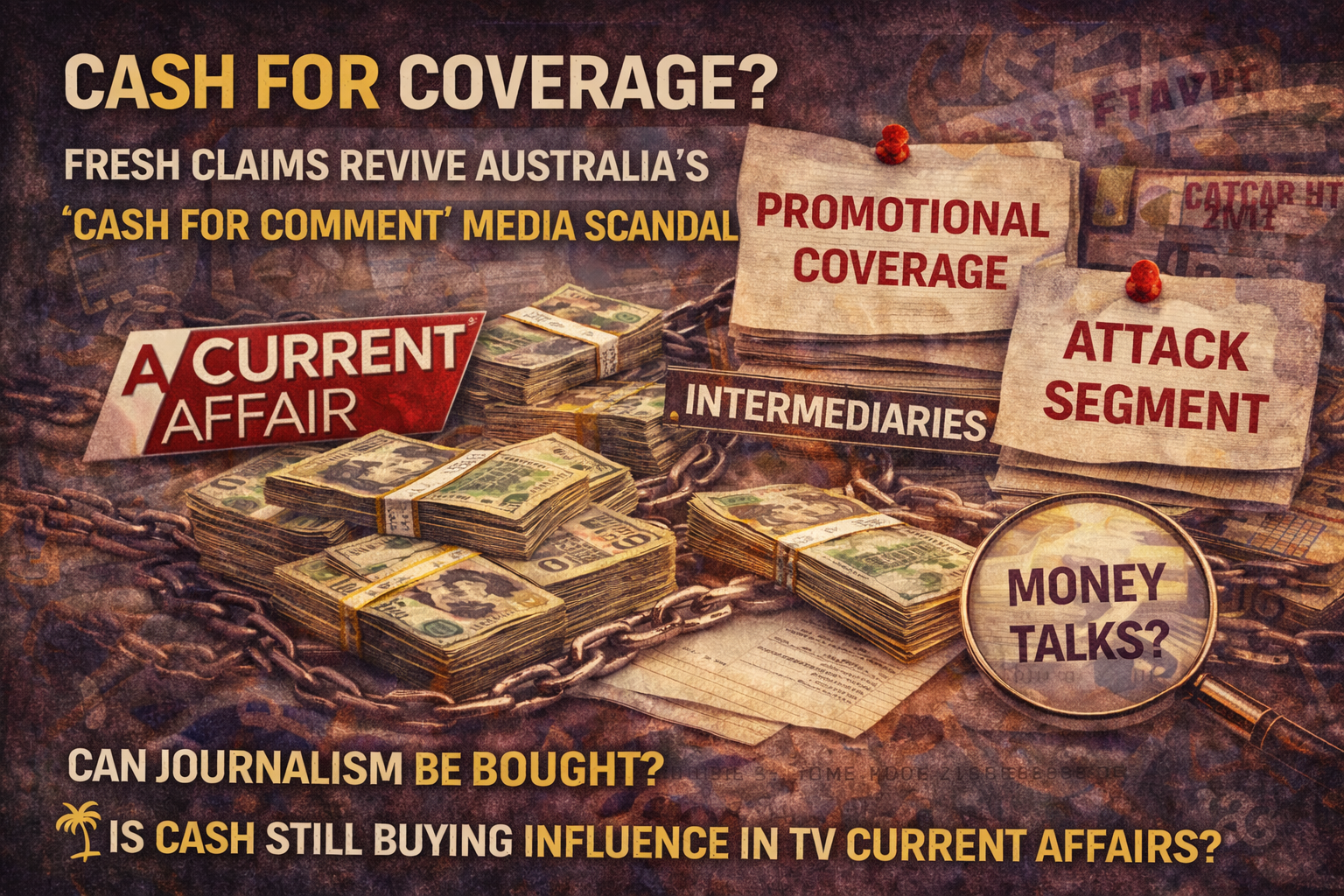
📰 Cash for Coverage?
Fresh Claims Revive Australia’s “Cash for Comment” Media Scandal
More than two decades after Australia was rocked by the infamous “cash for comment” scandal, new allegations are emerging that suggest the practice may not only still exist — but has evolved into a sophisticated shadow industry operating through intermediaries within the media and PR ecosystem.
According to multiple insiders from Australia’s media and public-relations sectors, intermediaries are allegedly charging between:
💰 AUD $75,000 – $250,000
to secure segments on high-rating current affairs programs, including formats such as A Current Affair on Channel 9.
These placements, it is claimed, can be arranged as:
📺 Glowing promotional features framed as investigative journalism
📺 Damaging “attack” segments designed to discredit competitors, rivals, or targeted individuals
If true, this would represent a disturbing continuation of the very practices that once brought Australia’s major networks into public disgrace.
⏳ A Scandal Australia Was Told Would Never Happen Again
In the early 2000s, the cash for comment scandal exposed how broadcasters were secretly paid by corporations to promote products and companies — while presenting the segments as independent reporting.
The fallout was severe:
⚖️ Regulatory reform
💸 Heavy fines
📜 Public promises of transparency
Australians were assured such conduct would never be repeated.
Now, insiders say it never stopped.
It simply went underground.
🕵️ How the Modern System Allegedly Works
Rather than money flowing directly from companies to networks, insiders allege payments are now routed through intermediaries — media fixers who claim access to producers, journalists, and editorial decision-makers.
These intermediaries allegedly “shop around” pricing based on the desired outcome:
📉 AUD $75,000 – $125,000 for a negative or “hit” piece
📈 AUD $150,000 – $250,000 for a positive promotional segment
⚡ Higher fees for urgent or strategically timed broadcasts
This structure allows broadcasters to maintain plausible deniability, while commercial influence occurs upstream, before a story ever reaches a newsroom.
📺 Why Tabloid-Style Programs Are Vulnerable
Critics argue that tabloid-style current affairs programs are structurally ideal for this type of manipulation.
These formats often prioritise:
🎭 Emotional narratives
🎯 Selective sourcing
📢 Dramatic framing
over forensic investigation.
As a result, they are seen as perfect platforms for corporate warfare disguised as journalism.
🔥 A Recent Case Brings the Allegations Back Into Focus
Recent controversy has reignited attention on these claims.
A company known as KINNARA has been accused by its critics of paying intermediaries to facilitate a damaging segment against a competitor that had previously bought it out of the Marina Bay City development project in Lombok, Indonesia.
According to those making the allegations, the segment was designed to:
⚠️ Pressure
⚠️ Intimidate
⚠️ Extract financial concessions
from the company that acquired the project.
It is claimed that payments in the range of AUD $75,000 – $125,000 were made to an intermediary.
That figure aligns precisely with what multiple independent media insiders describe as the “standard market rate” for arranging a negative or attack-style segment on Australian current-affairs programs.
⚠️ Allegations — But Troubling Consistency
These claims remain allegations and have not been proven in court.
However, the consistency of pricing figures quoted by independent sources has raised serious questions about whether a covert commercial market exists for manipulating mainstream television coverage.
If such a system exists, the implications are profound.
🚨 What’s at Stake If This Is True
If journalism can be bought indirectly through intermediaries:
🧨 Journalism becomes a weapon in commercial disputes
🧨 Viewers unknowingly consume paid influence operations
🧨 Public trust in media is systematically eroded
🧨 News becomes a commodity traded behind closed doors
In this model:
Truth is no longer discovered.
It is purchased.
🤫 The Silence Is the Most Alarming Part
When cash for comment was exposed in the early 2000s, it dominated headlines and parliamentary debate.
Today, similar allegations barely register beyond independent media and alternative platforms.
That silence raises uncomfortable questions:
❓ Has the public become desensitised?
❓ Are major networks now too powerful to challenge?
❓ Or has the system simply become more refined at hiding its tracks?
🧾 Conclusion: Journalism or a Market Transaction?
If intermediaries truly exist who can sell reputation destruction or reputational promotion for a fee, then the line between journalism and corporate influence has been erased.
The public is no longer watching reporting.
They are watching paid strategy disguised as investigation.
Until regulators, whistleblowers, or judicial processes force transparency, suspicion will only grow — along with the belief that Australian current-affairs television is no longer about informing the public, but about serving whoever is prepared to pay the highest price.


