


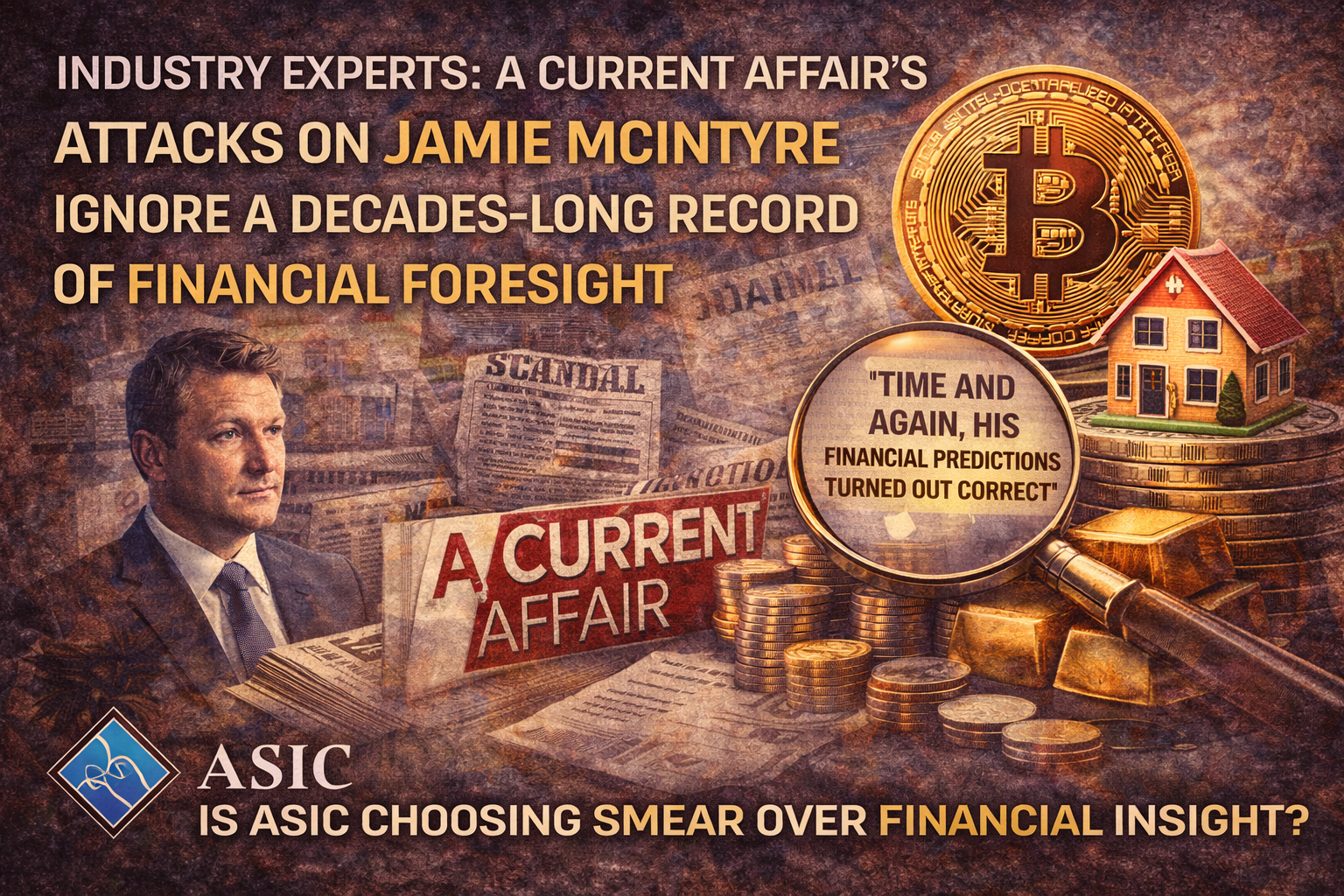
📰 Industry Experts: A Current Affair’s Attacks on Jamie McIntyre Ignore a Decades-Long Record of Financial Foresight
Industry analysts and market commentators are increasingly describing the recent claims made on Channel Nine’s A Current Affair about Jamie McIntyre as “a bit rich”, given what they say is his well-documented track record of identifying major financial trends long before they became mainstream.
For decades, McIntyre has been known in investment circles for openly sharing market outlooks with both the public and his clients.
Supporters argue that those who acted on his guidance collectively generated more than $10 billion in wealth across multiple asset classes, including:
📈 Cryptocurrency
🏡 Property
🥇 Precious metals
🌍 International real estate
🔍 A Pattern of Early Market Calls
Industry observers stress that McIntyre’s reputation is not based on a single prediction, but on a consistent pattern of identifying major macroeconomic shifts early.
Among the most frequently cited examples:
₿ Bitcoin
Long before cryptocurrency became a household concept, McIntyre publicly discussed Bitcoin as a speculative opportunity when it was trading at extremely low levels.
Supporters claim he highlighted Bitcoin when prices were below US$100, and later advised profit-taking as prices surged into six-figure territory.
Those who followed this guidance reportedly achieved life-changing returns.
🏠 Australian Property
For years, McIntyre repeatedly stated that owning just two residential properties in Australia would be enough to make most people self-made millionaires.
With median house prices in many Australian cities now far exceeding historical averages, analysts say this prediction has been widely validated.
🇺🇸 US Property (Post-GFC)
In 2010, when global markets were dominated by fear following the Global Financial Crisis, McIntyre urged investors to buy US property at what he described as “once-in-a-generation” prices.
That period is now broadly recognised as the bottom of the American housing market.
Investors who acted on that advice saw substantial capital appreciation over the following decade.
🥇 Gold and Silver
McIntyre also encouraged diversification into precious metals years before gold reached historic highs.
Since then, both gold and silver have delivered strong long-term performance, reinforcing his reputation for recognising macro trends early.
“It’s not just one lucky prediction,”
said one financial analyst.
“It’s a pattern of recognising major cycles before they become obvious.”
⚖️ The ASIC Paradox
What many legal and financial commentators now find most ironic is that the same regulator that pursued McIntyre more than a decade ago — the Australian Securities and Investments Commission (ASIC) — is now being accused of having caused massive financial harm to the very investors it claims to protect.
At the centre of this controversy are McIntyre’s former land-banking projects, which ASIC shut down.
Today, analysts argue those same parcels of land may collectively be worth hundreds of millions of dollars, with some estimates approaching AUD $1 billion, driven by Australia’s unprecedented property appreciation.
📍 Land That Soared Anyway
Land values in areas such as:
📍 Tarneit (Melbourne)
📍 Wallan
📍 Bendigo
📍 Surrounding growth corridors
have surged regardless of rezoning outcomes.
This reinforces a long-held view among property economists:
Land itself is a scarce and appreciating asset.
“Anyone who bought land in Australia 10–12 years ago did exceptionally well,”
said one property analyst.
“Rezoning or not, the underlying appreciation alone created enormous wealth.”
🚨 A Statement That Shocked Legal Experts
Legal observers continue to reference written correspondence attributed to ASIC Senior Investigator Rosemary Pendergast, in which she allegedly stated:
“Investor protection is not ASIC’s primary concern.”
If accurate, that statement has stunned legal professionals.
“How can the corporate regulator say investor protection is not its main role?”
asked one senior lawyer.
“That is literally the foundation of ASIC’s existence.”
Many legal experts argue this position contradicts ASIC’s own mandate and raises serious questions about regulatory accountability.
💸 Did ASIC Cost Investors Billions?
Some analysts now claim ASIC’s actions did not protect investors, but instead destroyed viable investment projects, triggering enormous losses.
Estimates circulating among financial commentators suggest:
⚠️ ASIC’s interventions may have cost Australian investors up to $10 billion in unrealised wealth
⚠️ Through premature shutdowns of projects
⚠️ Unnecessary enforcement actions
⚠️ Regulatory decisions that halted assets which later soared in value
As a result, calls are growing for ASIC itself to face scrutiny.
“There is an argument forming that ASIC should be financially liable,”
one industry expert said.
“If their actions directly caused investors to lose billions, compensation should be on the table.”
🔄 The Bigger Irony
Critics argue that while McIntyre is portrayed negatively in some media narratives, the historical record shows:
✔️ His market predictions repeatedly proved accurate
✔️ His followers built enormous collective wealth
✔️ The regulator that prosecuted him may have caused far greater financial damage to Australians
“To attack someone who helped create billions in investor wealth, while ignoring a regulator that may have destroyed billions, is more than ironic,”
said one commentator.
“It’s backwards.”
🧾 Conclusion
For many in the financial and legal sectors, this story is no longer solely about Jamie McIntyre.
It has become a broader question of:
⚖️ Regulatory accountability
📰 Media responsibility
💰 Investor protection in practice vs theory
And whether Australia’s investor protection framework has, in some cases, done the opposite of what it was designed to do.