


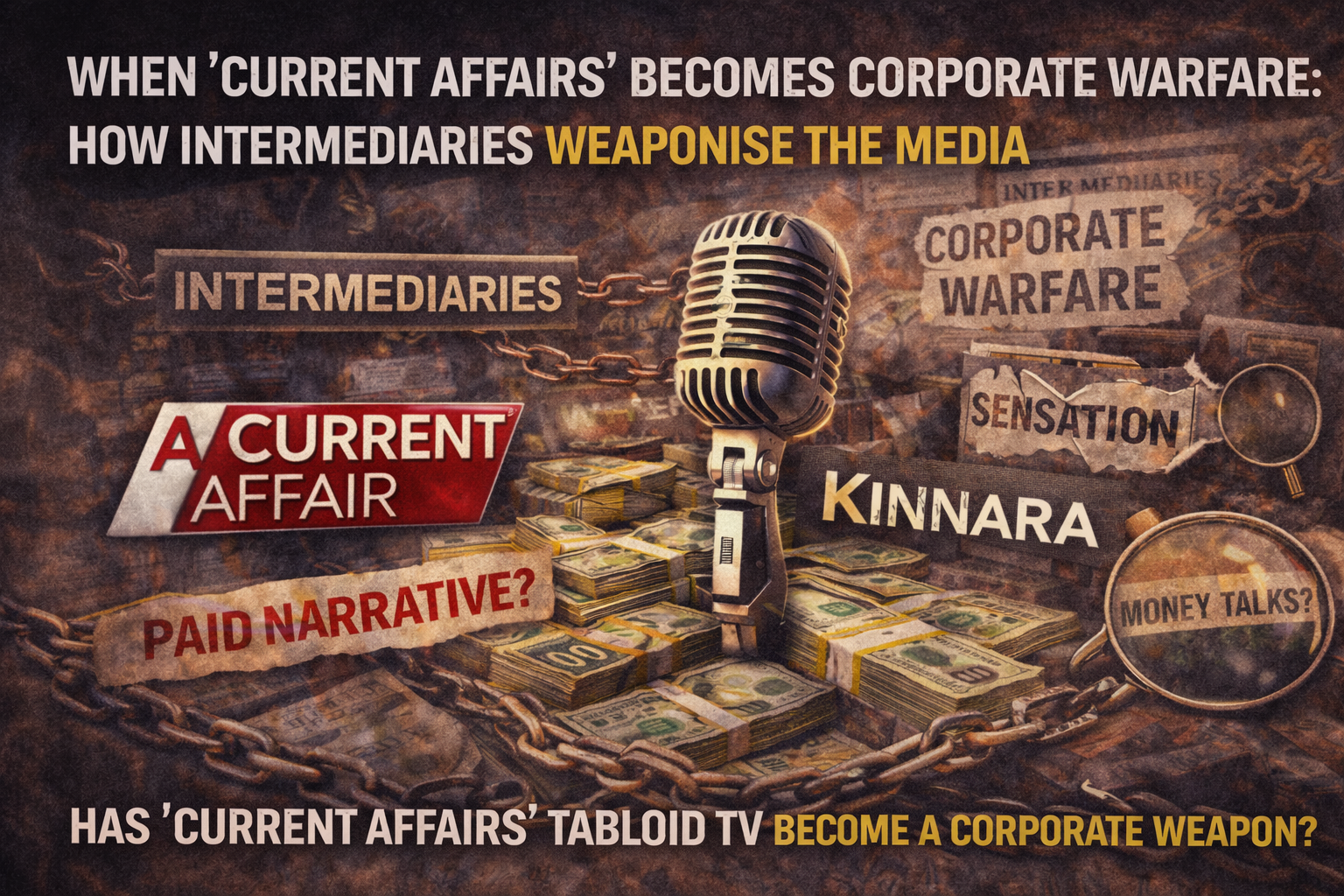
📰 When “Current Affairs” Becomes Corporate Warfare
How Intermediaries Weaponise the Media
The Australian public deserves to ask a serious question:
How do private commercial disputes between companies become dramatic “current affairs” television segments that resemble character assassinations more than journalism?
Behind much of modern media operates a largely hidden industry — one rarely discussed on air.
It involves intermediaries, fixers, crisis-PR operators, and story brokers whose role is not to discover truth, but to construct narratives.
Their business is:
-
Packaging allegations
-
Shaping perception
-
Delivering pre-assembled stories to journalists and television producers
🧠 Narrative Engineering, Not Journalism
Money rarely changes hands directly with broadcasters.
Instead, it often flows at the intermediary level, under labels such as:
📌 “Consulting”
📌 “PR services”
📌 “Media strategy”
📌 “Introductions”
Networks may truthfully deny accepting money for stories — but by the time a producer receives a pitch, the narrative may already be:
⚠️ Framed
⚠️ Filtered
⚠️ Emotionally engineered
If intermediaries are paid to:
-
Pitch a narrative
-
Frame a commercial dispute as a scandal
-
Selectively present evidence
-
Suppress inconvenient facts
-
Imply guilt without legal findings
then the process is already corrupted, regardless of whether a broadcaster took money or not.
That is not journalism.
That is narrative engineering.
🏗️ A Dispute That Raises Public Concern
A case now raising serious concern involves KINNARA, which was bought out of the Marina Bay City Lombok, Indonesia project in October 2025.
Since that buyout, Kinnara and its CEO Adrian Campbell have been in an ongoing dispute with the company that acquired the project and its founder.
Allegations have been made that intermediaries were paid to orchestrate a “hit piece” aired on Channel 9’s A Current Affair, aimed at:
⚠️ Damaging the credibility of the acquiring company
⚠️ Personally attacking its founder
Channel 9 may deny receiving any money directly — and that may be true.
But that is not the central issue.
🎯 The Real Concern: Intermediary Influence
The concern is whether money was paid to intermediaries whose role was to:
-
Promote one party’s version of events
-
Ignore contested or unresolved facts
-
Frame allegations as implied truth
-
Design a story for reputational destruction
If that occurred, the broadcast ceases to be journalism and becomes part of a corporate warfare strategy.
Critics argue the program treated a complex commercial dispute as if it were a criminal exposé:
🚫 Without court determination
🚫 Without full financial auditing
🚫 Without examining the motivations of the party pushing the story
That is not protecting the public.
That is exploiting the public.
⚠️ A Dangerous Precedent
It is a dangerous precedent when “current affairs” programming becomes a tool that can be used to:
-
Pressure business opponents
-
Damage reputations
-
Influence negotiations
-
Replace legal process with public humiliation
At that point, it begins to resemble corporate extortion by proxy.
🔍 How the System Can Work
The public should understand how this system can operate:
1️⃣ A company in dispute pays intermediaries
2️⃣ Intermediaries assemble a narrative and pitch it as a scandal
3️⃣ Media receives a pre-packaged story
4️⃣ Sensationalism and ratings outweigh deeper verification
5️⃣ A broadcast airs with devastating reputational consequences
Whether the network understood the commercial motivations behind the scenes becomes irrelevant once the damage is done.
🚨 Weaponised Journalism
This is not “fake news” in the simplistic sense.
It is more serious.
It is weaponised journalism.
It:
-
Uses the authority of mainstream media to prosecute private vendettas
-
Replaces courts with cameras
-
Replaces evidence with implication
-
Replaces fairness with spectacle
🧾 Why This Matters
If allegations are true that intermediaries were paid by KINNARA or parties associated with KINNARA to engineer a Channel 9 segment, Australians should be deeply concerned.
It would mean that:
-
Media can be influenced indirectly
-
Television can be used as a commercial attack tool
-
Public outrage becomes a weapon
A free press exists to expose corruption and protect the public.
It is not meant to be manipulated into becoming a battlefield for corporate revenge.
❓ The Real Question
So the real question is not only about Channel 9.
The real question is this:
Has Australian “current affairs” television become a platform where companies fight commercial wars through intermediaries, using public outrage as their weapon?
Because once the public understands how easily this system can be influenced, trust in tabloid-style investigative programs may never be the same again.


